Mountain of Many Voices
March
2025
2025–2026 · Hypertext narrative, installation, and performance
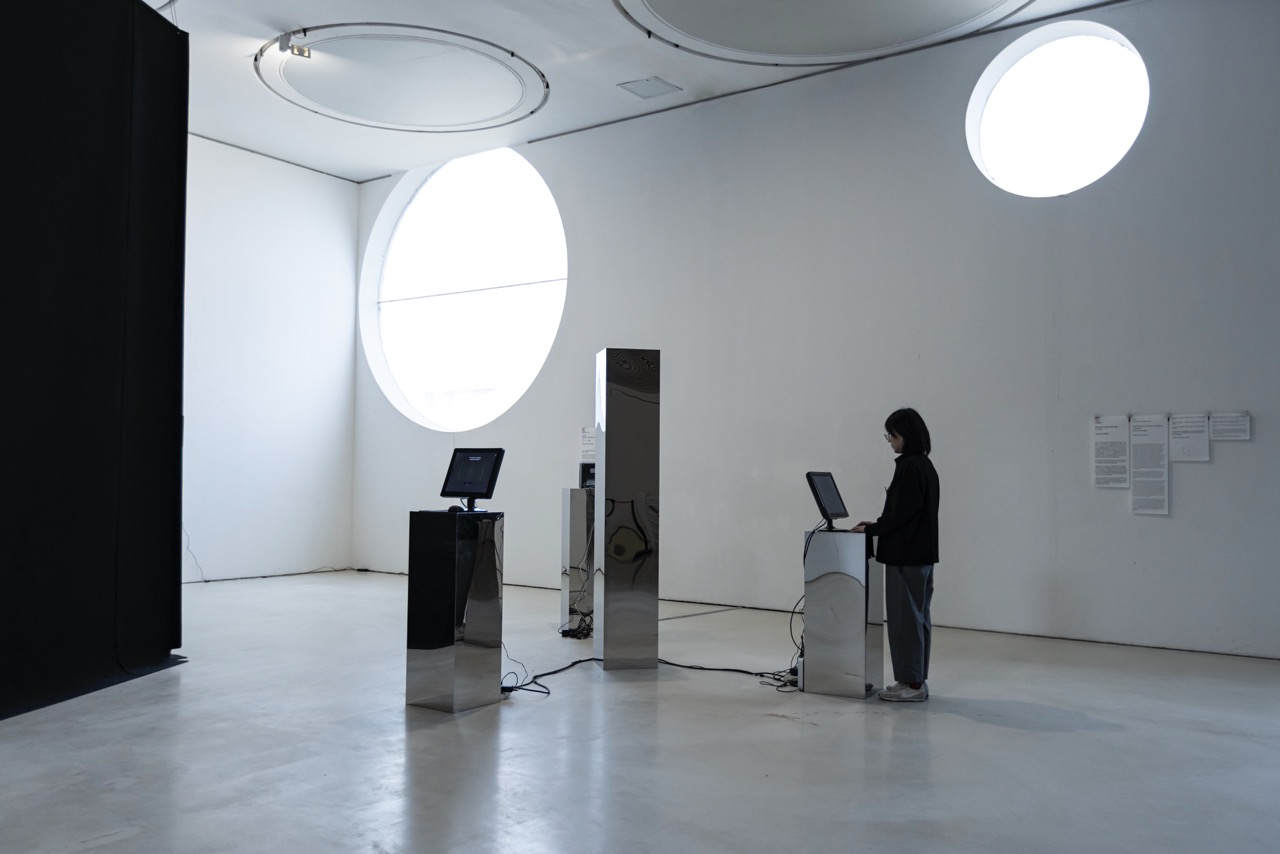
Installation view, Times Museum, Guangzhou, March 2025. Photograph: Pengjing (彭婧).
A hypertext narrative with shared memory
Mountain of Many Voices (MoMV) takes the form of a hypertext narrative, encountered through installations and performances. Players return to a childhood home altered by urbanization, then ascend a mountain where personal recollections mingle with memories that have no single narrator. Choices made along the way are retained and can return within later passages, shaping the world encountered by other players.
It is an experiment, or a work of research-creation, on the conceptualization of technical memory, concerning our ability to “return”: an investigation of the conditions in which the past could live. The research and the creation braid into each other, thus producing a myriad of different outcomes, such as installations, performances, essays, software systems, and diagrams.
The work asks how encounters with a computational system can become conditions of what it does next. In the interactive narrative, its writers establish the story’s initial world and the procedures through which earlier choices return. A large language model is used very sparingly to compose selected records into new passages through interpretive frames authored for the work. As a result, each subsequent player enters a world with an accumulated history and leaves traces that may affect its continuation.
First commissioned by and presented at Times Museum in 2025, MoMV was subsequently adapted for performances at Hart Haus, Hong Kong, and Asia Art Archive in America, Brooklyn. The English-language version presented through Rhizome’s Counterstructural Commons residency with Mozilla Foundation in May 2026 locates the story among car factories, diners, and arcades in a town marked by industrial decline.
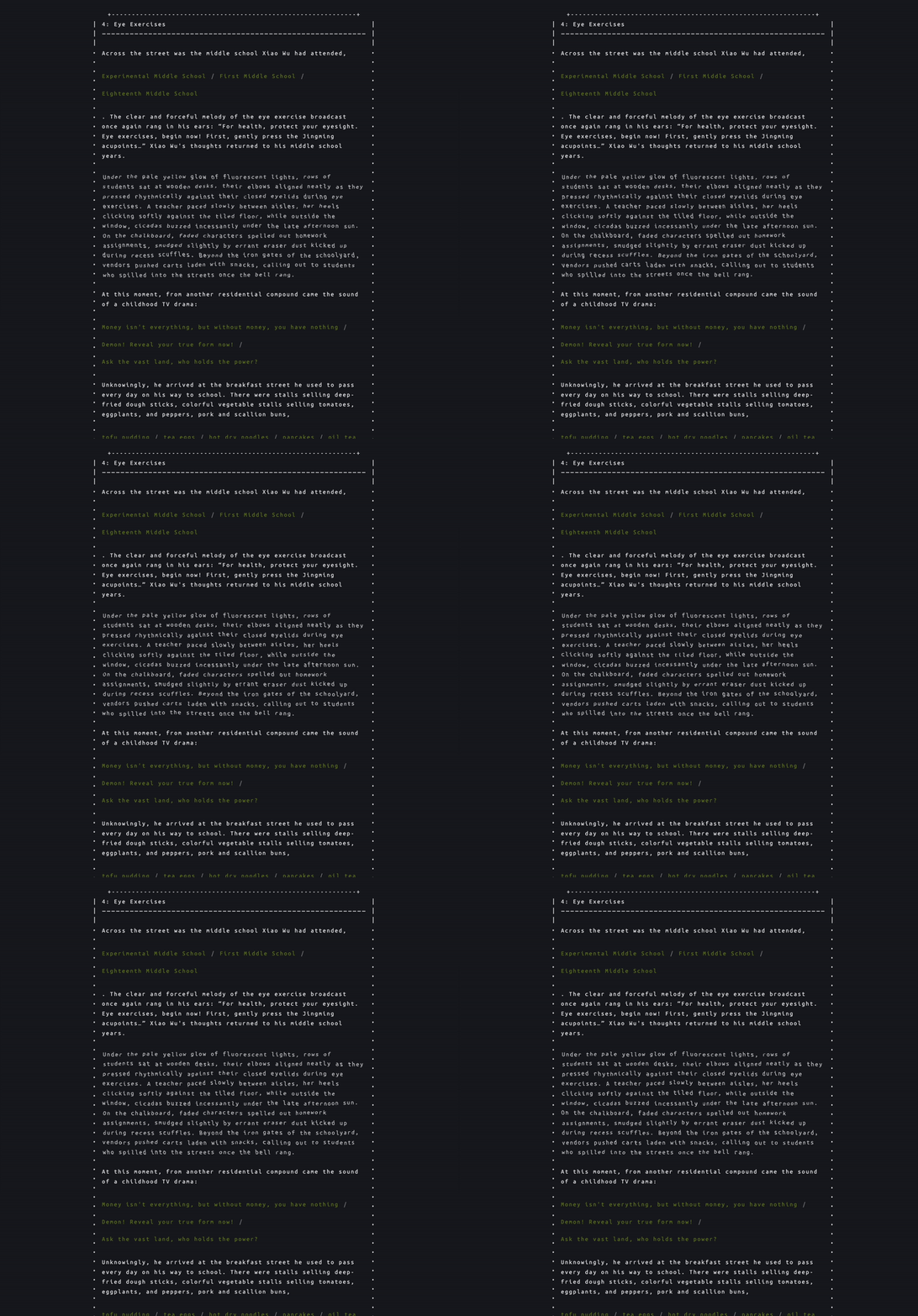
A generated passage appears as moving, wavy text within the authored narrative.
At the end of a traversal, the participant’s path is combined with artist-designed ASCII patterns to produce a talisman. In the installation, a thermal printer gives this record a temporary material form.
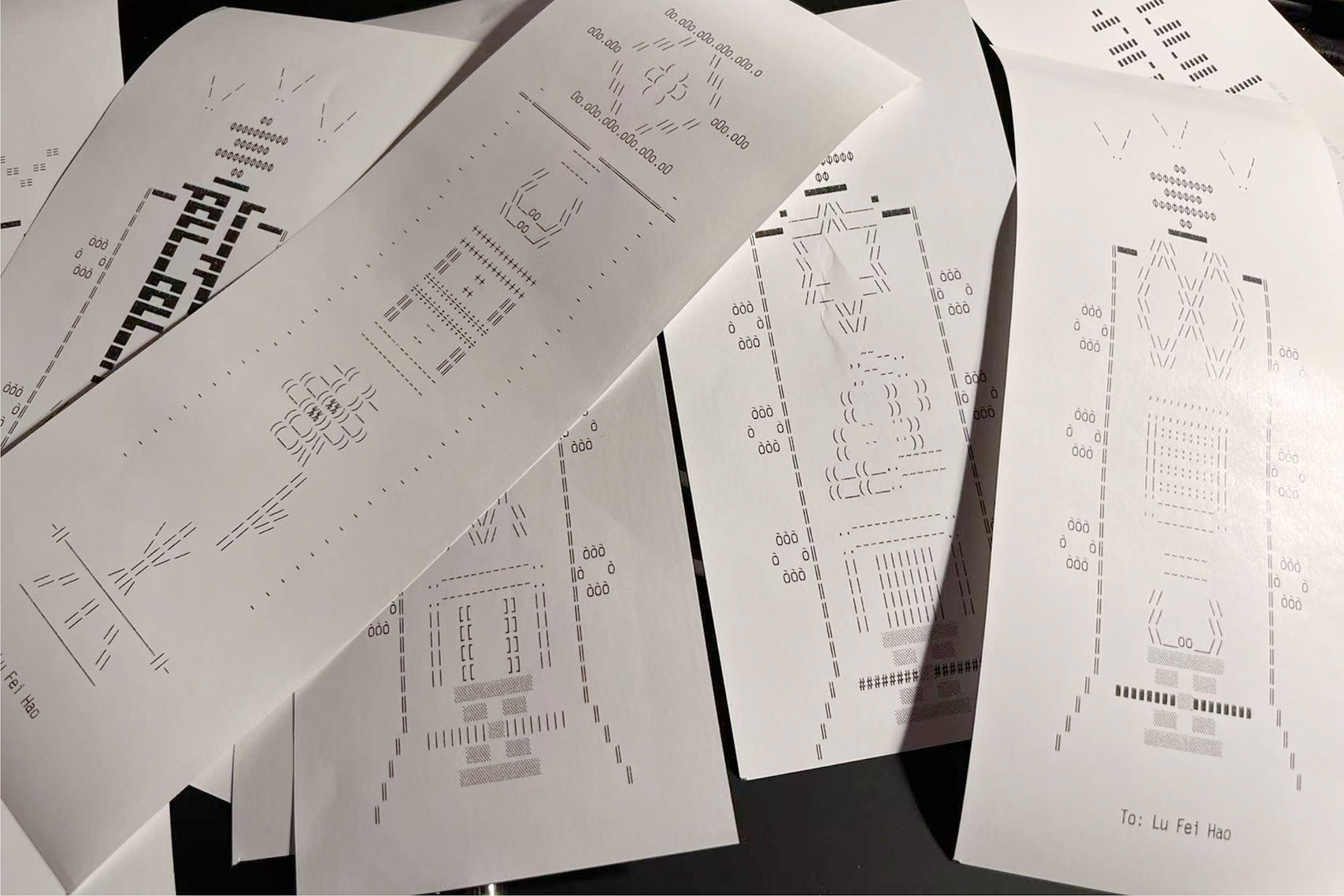
Talisman prints from the installation.
How retained choices shape later encounters
Infrastructure is the ground on which social and cultural life takes place, and its design shapes what can be thought and done within it.
We could borrow the soil analogy here to think through the temporal dimension. Soil accumulates the effects of what has lived in it (living plants change its composition, dead plants decompose and become nutrients, etc.) and conditions what can grow next. MoMV approaches technical memory through this relation between accumulated history and future possibility. Memory here—or, in a phenomenological register, “retention”—plays a central role as the “ground.”
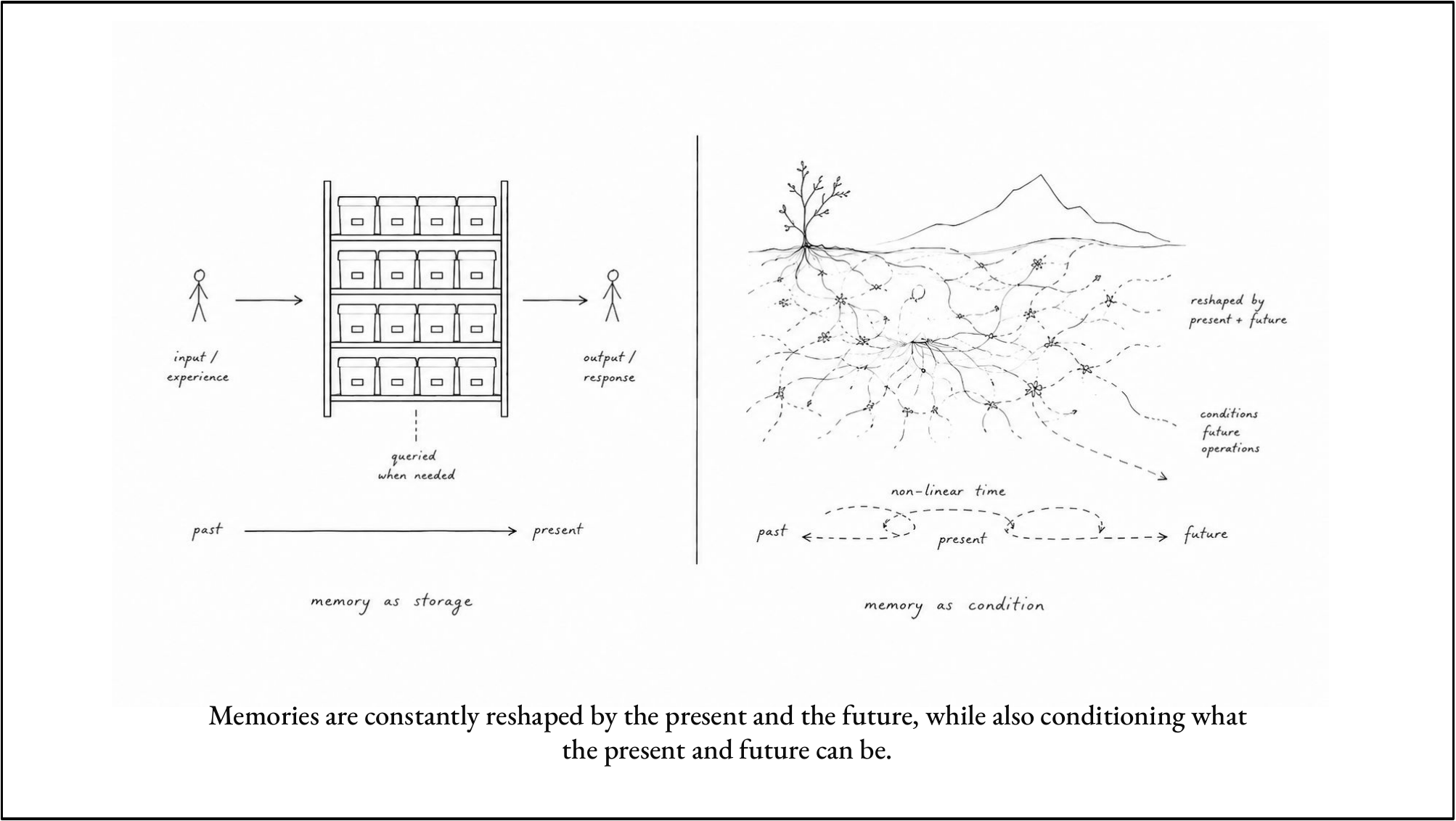
Memory as storage / memory as condition. Slide 3 of the Rhizome/Mozilla presentation, May 16, 2026; slide area reproduced without speaker notes.
In MoMV, memory participates in the composition of the world a player encounters. An earlier selection can return as the atmosphere of a scene, an object, or a character’s response. Its significance develops through the later situation in which it appears and through the player’s interpretation. People who never meet can therefore participate in the formation of a shared narrative world.
We describe this relation as:
“Memory is identity; identity is working memory.”
The work acquires a history through the encounters it retains. Its governing procedures remain relatively stable during a deployment, while the memory they draw upon changes. What differentiates one state of the work from another is partly what has happened within it and how those traces enter its next operation.
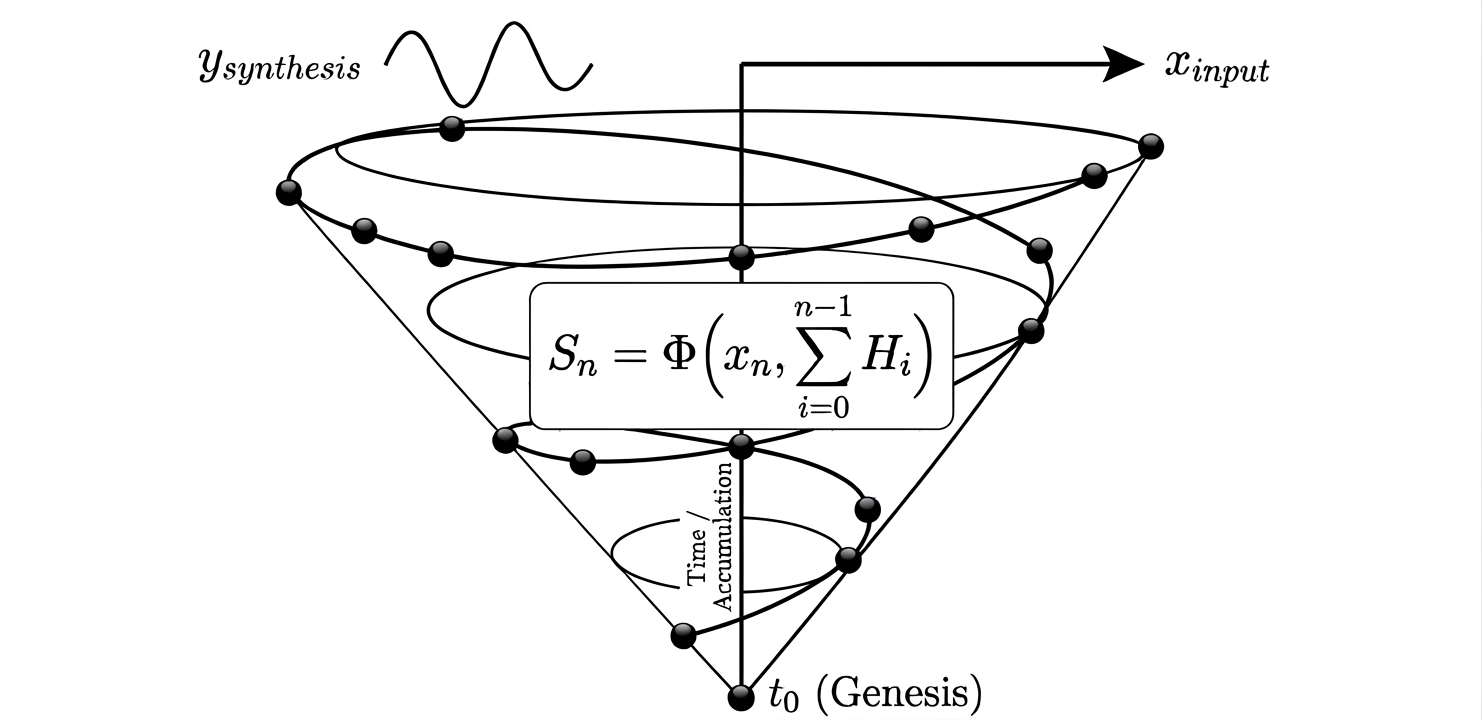
Accumulation cone: successive encounters build on retained history. At each generation step, authored retrieval selects which records enter the context for composition.
Since the current paradigm uses the database as the technical form of retention, the project concerns a new paradigm of the database—or something beyond the database that does more than serve data. The questions concern:
- What gets stored;
- How they are stored (here, the identity of “they” is already being transformed);
- How the past (we can no longer use “them” to refer to a stable signified, as they might have changed identity by this point) affects the future.
This relation depends on how the system carries traces (past inputs) forward. New records are appended to the database, preserving the order of recorded events. Retrieval can follow one participant across a traversal or gather different participants’ responses to a particular question. The writers specify these relations in a custom editor, alongside fixed narrative passages and the points at which generation can occur.
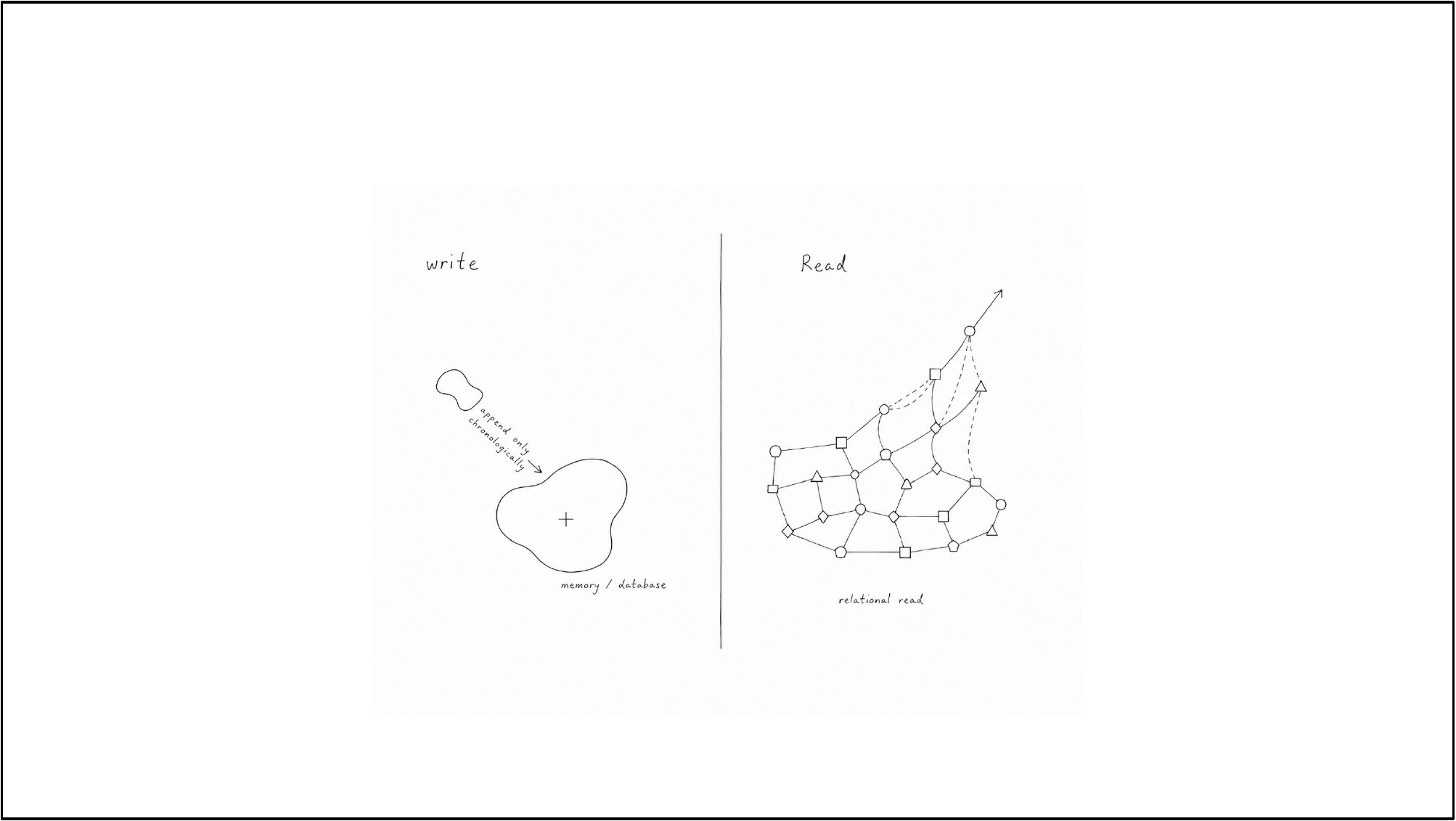
Append-only writing and relational reading: two forms of interacting with the past/database. Extracted from the Rhizome/Mozilla presentation, May 16, 2026.
An interpretive frame directs how the retrieved material enters the current scene. In the English-language version, a choice made in Chapter Two, “The Yard,” returns in Chapter Three, “Spin-City Records,” through a frame drawing on Jungian psychology. Elsewhere, accumulated choices from different players are composed through an I Ching frame. These frames give the language model a situated compositional role within the work. Its generated text becomes available for a player to read, interpret, and respond to; a partial record of that response can then enter another encounter.
Research statement: memory and agency within systems
Mountain of Many Voices (MoMV) is a research-creation artifact.
The project concerns time, memory, systems, and configuration within cybernetic systems.
Cybernetics, especially second-order cybernetics, gives us a way to describe the condition in which we live: inside technological systems that we also observe, inhabit, and alter. If we say that software has become infrastructure — if by this we mean that it has become the ground, the soil that conditions what can exist, live, and grow — then we are saying more than that software, and to an extent the net, is where culture and, more fundamentally, thought happen. We are also saying that the ways these structures are designed and engineered — their forms and paradigms — become the limits of how rich, open, and generative thought and culture can be. The question of how anything — freedom, agency, the ability to alter the trajectory of the system we live with and within — can still happen becomes urgent.
LLMs intensify a familiar software paradigm: the transformation of human intention into system-readable input, and the return of system-generated possibilities as if they were neutral options. We try to approach this question through creation as a way of thinking, with making and coding as a kind of notebook. Through this process, we ask: what kind of design could preserve contingency — that is, the will and intention to alter the trajectories of systems — as produced by users, players, and all those who use and inhabit the system?
These questions have to do with time: with the temporal dimensions of systems, with what has been accumulated and produced, and with how we deal with them.
This leads us to think about a new kind of machine, one that treats “memory” differently. Memory is never inert, stored as a mere pile of bits or “data,” a quantitative accumulation that can be seen as discrete, queryable units like numbers.
Contrary to the popular notion, memory is not inert, standing still in the past as a relic. Memory becomes the ground for what comes next, and it is constantly reshaped by what comes next. Memory is identity; identity is working memory.
We ask: what if software had a more intimate and functional relationship with its memory? What if memory did not stand outside the operation of the system, but became the organizing procedure of the system?
MoMV is itself one way of asking that question through creation. It proposes a novel architecture that gives AI a different role in the system: a mediator, with authorial steering, a node inside the web of meaningfulness. Its output becomes meaningful only when it is taken up by writers and players within the evolving world of the work. AI here is neither the author of the work nor a replacement for human making. It functions as a mediator inside a world shaped by writers, players, and accumulated memory.
Written for zzyw, Mountain of Many Voices, Rhizome presentation materials, 2026. Final print version. Read the poster PDF.
Publication: Counterstructural Commons
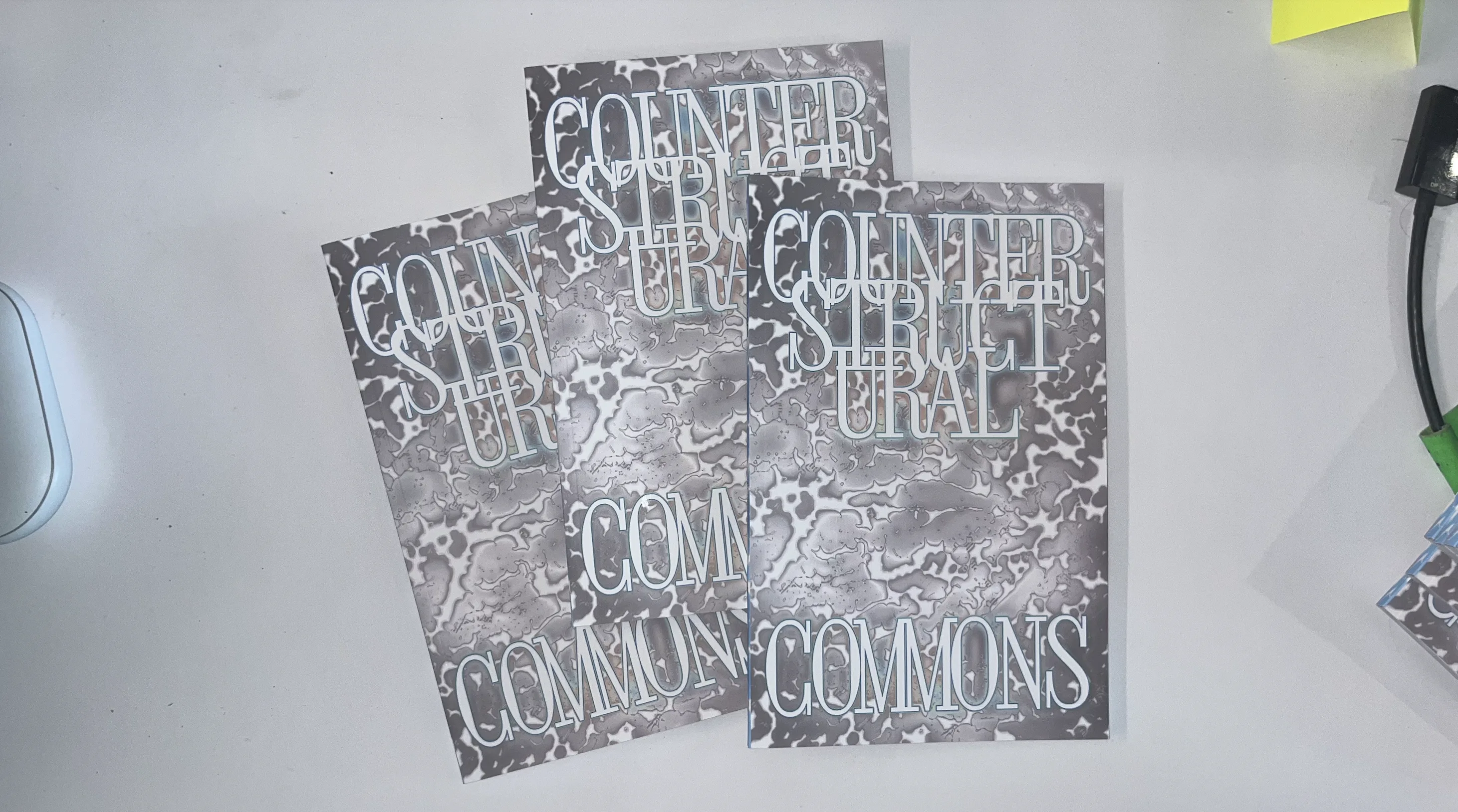
Printed copies of Counterstructural Commons, published by Rhizome, 2026, with support from Mozilla Foundation. The contribution “Mountain of Many Voices,” by Zhenzhen Qi and Yang Wang, appears on pp. 26–32.
The publication develops a broader system proposal through the image of a library whose books and shelves can be rearranged by use. It extends the inquiry toward changes in a system’s computational organization, beyond the narrative implementation described above.
Presentation materials and publications
- Mountain of Many Voices — final presentation. zzyw, Rhizome/Mozilla, May 16, 2026. Slides and speaker notes on memory, narrative, and the authoring system.
- Mountain of Many Voices — poster. zzyw, 2026. Research statement and annotated diagram of the encounter–memory cycle.
- “Mountain of Many Voices,” in Counterstructural Commons. Zhenzhen Qi and Yang Wang (ZZYW), Rhizome, 2026, pp. 26–32 (PDF pages 41–47).
All textual and visual materials on this website may be cited, referenced, or reproduced for scholarly, educational, or personal non-commercial use with appropriate attribution. Scraping, harvesting, or extraction of content for any purpose requires explicit prior authorization. Unauthorized scraping, particularly for commercial purposes—including the training of machine learning models—is strictly prohibited.
© Yang Wang, Zhenzhen Qi 2023 | All Rights Reserved