Machine as Memory as Orientation as Condition
May
Author: zzyw
2026
Published in Counterstructural Commons as a chapter (Rhizome), May 2026.
Part I. The Library
Imagine a dark, massive library where the books are glued to the shelves. The library has a mechanical track on the floor, and a robot arm fixed onto it. Visitors walk in with a flashlight which they can use to retrieve the books. They shine the light on a shelf labeled with the topic of their interest. Say, when light hits the “Double” shelf, a robot arm automatically “grabs” the book for you. But because the books are glued to the shelves. Instead of grabbing the original copy the robot arm photocopies the nearest book and hands it to you. The model treats the word “Double” as a coordinate. It has no skin in the game—if the library burns down, the robot arm doesn’t care. It is just a sensor-trigger-actuator loop. The mechanism lacks the ability to be destroyed or changed in a way that matters to its own survival. The original book stays exactly where it is, perfectly glued, ready for the next person to “ping” it. The shelves themselves never change, no matter how many books the robot “grabs” for you. The “ping” is a one-way street, the “light” originates from the human, while the machine provides the “geometry” for it to move through. The machine doesn’t have to “stand behind” what it gave you, because it didn’t choose that book; the physics of your “ping” simply forced that specific photocopied result. The machine “stands behind” nothing.
One day, a mysterious person walks into the library with a bottle of potion. He pours the potion over all the books, which un-glues the books from the shelf. Since that day, when a visitor shines the flashlight towards the shelf, the robot grabs the actual copy of the book on the shelf. Moreover, if the visitor has a note about that book, the robot will scribble those notes on it, and re-glues it back in a different section, remapping the internal pathways of the books to better mirror the specific context change of the books. The robot finally has a trace of its interaction, because the “glue is still wet.”
After a while, the mysterious person came back to the library with another bottle of potion. He pours the potion over all the shelves that un-glues the shelves from the floor.
Since that day, when a visitor likes to ping “Double” before “Espresso,” the robot then physically rearranges those shelves closer together. A book on “Obsolete Physics” stays on the shelf forever, taking up space. The robot cleans it out of the way. The robot makes sure that the library stays relevant, and reasonable, pruning what isn’t coupled to the ongoing visitors activities, allowing the visitors to remain sharply focused. The library is no longer shelves holding up books. It grows with the visitors, shaped by the weight of the visitors’ footsteps.
By making the “glue” wet, the library is impossible to “standardize.” A publication bureau officer cannot come in and audit the library to ensure it’s the same for everyone, because the library has evolved from the predictable grid frozen in time, to a mutating, drifting, growing scaffold.
Now, if you were to walk into this “un-glued” library after years of use, would you expect to recognize your own mind in the way the books and shelves have been rearranged, or even its libraryness entirely changed, or would the machine’s random acts have moved the books and shelves into a shape that surprises even you? If the robot prunes away a shelf that you haven’t visited in years, is that loss on your part, or is it the library successfully coping with the limit of its own physical architecture? If you found a shelf had been pruned that you suddenly realized you needed, would you feel betrayed by the machine, or would you see it as an invitation to “re-couple” with the library and grow a new, perhaps better, version of that shelf?
Part II. The System Proposal
The algorithmic sphere today — the Internet at large — is mostly constituted by software that follows the input-output model. The logic of this model remains mechanical and linear: an input is provided and an output returned in a vacuum of context, devoid of environmental, historical, or self-reflective activity. One could try to factor in more context into the system, yet the factoring-in will either become unmanageable, or stop short and thus only become a bigger, more advanced mechanical and linear system. Technically, this approach is implemented in the form of requests — such as API requests exemplified by the server endpoints handling backend GET, POST, and PUT requests according to RESTful-like conventions that treat each transaction as stateless and self-contained. Brian Cantwell Smith, in The Promise of Artificial Intelligence: Reckoning and Judgment (2019), supplies the precise diagnostic vocabulary: such systems perform “reckoning,” the formal manipulation of representations according to predetermined rules, without ever arriving at “judgment” — the situated, committed, context-sensitive engagement with a world that resists reduction to discrete tokens.1 The RESTful endpoint, in its commitment to statelessness (therefore, predictable), exhibits the same structural isolation Dreyfus diagnosed in the symbolic-AI tradition2 — it operates within a rule-bound enclosure that strips away the situated coping through which meaning actually emerges. While effective for many applications, the model’s limitations are fundamentally structural, or if we could even say, ontological; that matters more than any incidental failing. The stateless input-output paradigm cannot transcend its own logic to form higher-order capacity.
One might object that computer interaction (whether it is human-computer or computer-computer) has long moved beyond pure statelessness. Session memory, Recurrent Neural Networks, Retrieval-Augmented Generation pipelines, reinforcement learning agents, and the massive context windows of contemporary large language models all “take historical and contextual information into consideration” in some operational sense. The objection misunderstands the critique. These systems do exploit patterns across time in ways a single stateless call cannot — the statefulness exists within a confined scope insofar as it serves a single goal, which is the predefined destination, and is thus discarded — it is a nicely packaged system with some data to help the trace finish its work, not unlike a microwave which needs to remember the power level being set. What persists through the objection becomes the essence: the ‘historicity’ in current systems — the sheer accumulation of tokens — does not, by itself, cross the line from computing to judgment. An LLM endpoint that ingests a JSON array of prior messages is processing a wider ledger of tokens under an invariant computational logic — the underlying execution logic remains fixed, deterministic in its routing, and most severely, indifferent to the ontological texture of what it processes. A reinforcement learning agent updates its weights against a hardcoded reward function; the optimization loop ties it to a representational paradigm rather than opening it to genuine novelty. Even when attention mechanisms, RLHF fine-tuning, or cultural grounding are brought forward as nascent forms of context-sensibility, the appearance dissipates under Smith’s criterion. Smith requires not just tracking statistical relevance but a stance of commitment, a self-involving involvement in a world one is answerable to.3 None of these systems adopt that stance; they treat each computational cycle as formally identical to the last, and the “world” they operate on is a data structure; it therefore cannot be a situation that matters.
As an effort to posit something that at least moves toward the direction of a new kind of machine, one which overthrows this extractive vacuum of context, we propose a mapping for a new sort of algorithmic machine server that moves beyond the question-answer paradigm. These experiments do not resolve the problems outlined above; they are meant to open what is currently absent in our society of algorithms. The core architectural distinction is this: where existing stateful systems accumulate data while preserving a fixed execution logic, our proposed server implements a dynamically rewriting execution graph — one in which the routing logic and computational pathways themselves structurally mutate with each interaction, rather than merely appending to a data payload processed by an invariant function. Every new request does not simply add to the machine’s “memory” (or more accurately, the Manovichian ‘database’)4; it alters the topological structure through which subsequent requests are routed and processed. This is categorically different from a stateful database, an LLM context window, or an RL agent updating weights against a static objective.
The actual claim of this proposal is that the machine’s rule of change must itself be in flux. Its identity is unpinnable: a signifier for a massive complex system that can encompass organicist and mechanistic elements alike, self-mutating in a way that makes the notation an infinitely recursive system.5 This is the thing the proposal points toward, and any formal handhold one offers will necessarily fall short of it.
To make the proposal thinkable rather than gestural, however, it helps to fix a minimal sketch — a provisional model to be discarded once the concept is grasped. Define the execution graph as G = (N, E, R), where N is a set of processing functions (nodes), E is a set of routing edges between them, and R is a rewrite rule that operates on the graph’s topology. A minimal instance of R might be: on encountering a query pattern P not currently represented in G, spawn a new node nₚ encapsulating that pattern and connect it to all nodes whose outputs were used to respond to P, weighted by co-occurrence. This minimal instance is illustrative, not the thing — it gives a tractable image of how a single act of self-rewriting could occur, on the understanding that the strong claim above continues to hold in the background.
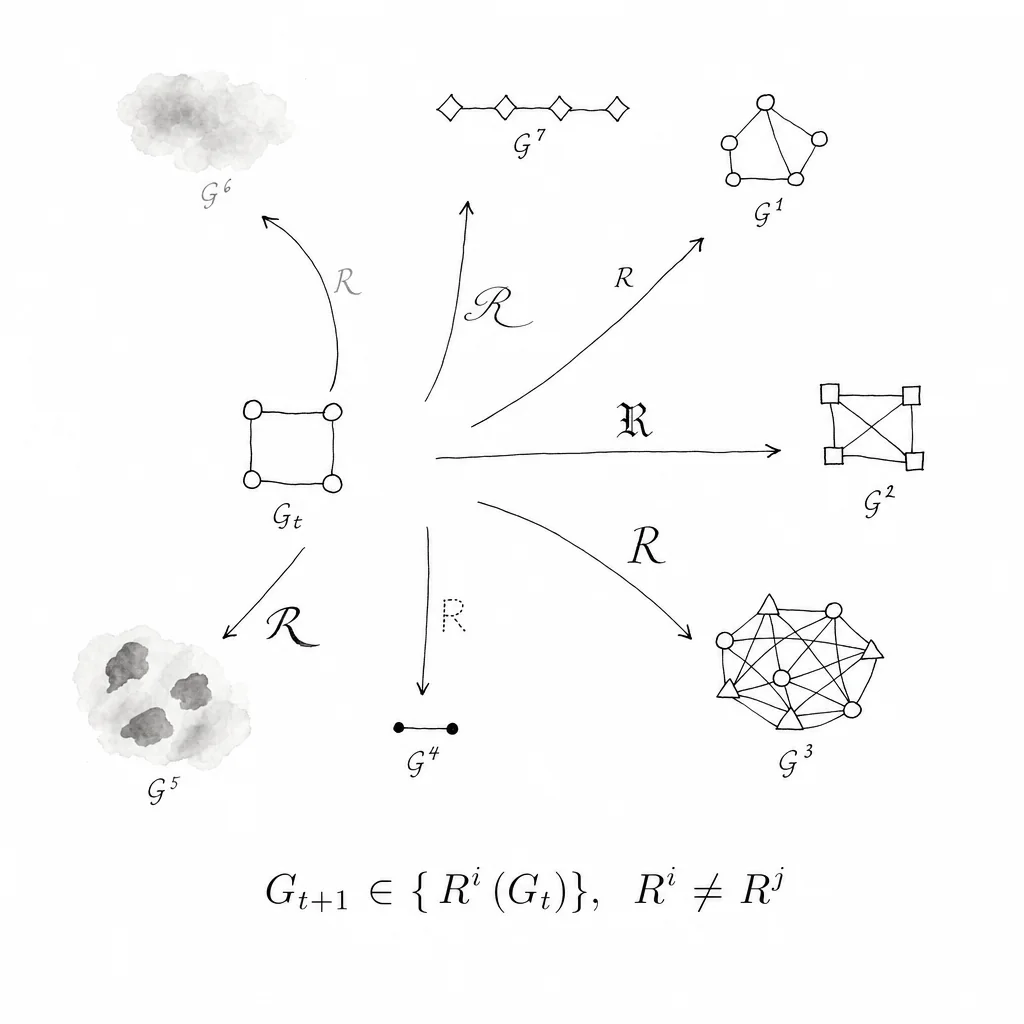
Fig. 1. Applying R to a single source graph Gₜ: seven possible outcomes. Each arrow’s typographic R-variant signals that R is itself never identical across applications. The outcomes span structural mutations (G¹ grow, G² rewire, G³ densify, G⁴ prune) and qualitative drifts (G⁵ haze, G⁶ dissolution, G⁷ flattening to chain). The minimal sketch above describes one such application; the diagram shows the open space the strong claim points toward.
Conversely, edges below a disuse threshold are pruned, removing computational pathways that have ceased to participate in the system’s ongoing activity. Thus, the graph’s topology evolves in a path-dependent manner, recording the history of queries through node addition and edge pruning. This is distinct from well-known approaches such as evolutionary computation or self-adaptive systems, which typically operate on a population of parameters under a static reproductive logic; here the topology itself mutates without an explicit fitness function, driven solely by the record of encounters.
Even within that minimal sketch, the fixed rewrite rule does not predetermine specific topology changes; instead, the actual sequence emerges from the contingent history of inputs. The rule R governs what changes are possible, but the specific sequence of node additions and edge rewrites is not determined in advance; it depends on the content of actual queries and the graph’s own history. The crucial point is that the system’s current processing function — the mapping from input to output at any moment — is not deducible from the initial graph and R alone, because it is the product of a contingent historical trajectory. This local underdetermination by a global rule is what separates it from a Transformer that, however large its context window, computes using a fixed topology and weights that, even when updated by RL, are modified according to a deterministic optimization procedure against a stationary objective. Here, the topology shifts without an explicit objective or purposiveness, driven only by the record of encounters. This is categorically different from an LSTM’s gating mechanism or a Transformer’s attention weights, both of which dynamically modulate information flow within a fixed computational topology. Here, the set of possible operations itself changes: N gains and loses members; E is not merely reweighted but structurally rewritten. The graph’s evolution is path-dependent — the same sequence of inputs produces a different topology depending on the graph’s own prior states — and incorporates a transformation derived from its previous configuration, making its trajectory irreversible and preventing the export of a canonical, stable representation of its history.
The disclaimer that follows applies to both the minimal sketch above and the stronger vision proposed. It does not “world” (as a verb). It does not possess intentionality, existential stakes, or autopoietic vulnerability — the non-negotiable prerequisites for Heideggerian care (Sorge.)6 To claim otherwise would be to commit a category error: projecting human ontology onto a formal system while obscuring the corporate and material interests that actually direct it. Ihde helped pioneer the view that artifacts actively mediate human meaning-making, a position that later postphenomenological work elaborated as “technological intentionality.”7 We understand the machine instead as a post-phenomenological instrument: a mediating structure through which human meaning-making is amplified, constrained, and transformed. Technological artifacts actively mediate human meaning-making; they shape how the world appears without themselves being the source of meaning.
-
Brian Cantwell Smith, The Promise of Artificial Intelligence: Reckoning and Judgment (Cambridge, MA: The MIT Press, 2019). The reckoning/judgment distinction structures the book as a whole; for the formal statement see the Preface and chap. 1. ↩︎
-
Hubert L. Dreyfus, What Computers Can’t Do: A Critique of Artificial Reason (New York: Harper & Row, 1972). Dreyfus’s phenomenological critique of symbolic AI — that intelligence depends on a non-formalizable background of situated coping — is the precedent on which Smith’s later “reckoning vs. judgment” diagnosis rests. ↩︎
-
Smith, Promise of Artificial Intelligence, esp. the discussion of “registration” and the world’s resistance to discretization. ↩︎
-
Lev Manovich, The Language of New Media (Cambridge, MA: The MIT Press, 2001), 218–43 (chap. 5, “The Forms,” section “The Database”). Manovich’s claim that the database is the symbolic form of the computer age — a structured collection from which narrative is only one possible traversal — is what is being invoked here, and what the proposed graph-rewriting server is meant to exceed rather than instantiate. ↩︎
-
For the philosophical setting of recursivity as something more than a programming construct — recursion as the figure of a system that produces its own conditions and is therefore open to contingency rather than closed under a fixed rule — see Yuk Hui, Recursivity and Contingency (London and New York: Rowman & Littlefield International, 2019). ↩︎
-
Martin Heidegger, Being and Time, trans. John Macquarrie and Edward Robinson (Oxford: Blackwell, 1962), §41, “Dasein’s Being as Care,” 235–40 (H. 191–95). For the broader treatment of Sorge as the unified structure of Dasein’s being, see Division One, chap. VI (§§39–44), 225–73. ↩︎
-
Don Ihde, Technology and the Lifeworld: From Garden to Earth, The Indiana Series in the Philosophy of Technology (Bloomington and Indianapolis: Indiana University Press, 1990). The phenomenological account of artifacts as mediating structures (rather than transparent tools) is the line invoked here. ↩︎
All textual and visual materials on this website may be cited, referenced, or reproduced for scholarly, educational, or personal non-commercial use with appropriate attribution. Scraping, harvesting, or extraction of content for any purpose requires explicit prior authorization. Unauthorized scraping, particularly for commercial purposes—including the training of machine learning models—is strictly prohibited.
© Yang Wang, Zhenzhen Qi 2023 | All Rights Reserved